
Some Thoughts on Sustainable Agriculture
Mohammed Ataur Rahman, PhD, M.Sc. and DIC
Director, Centre for Global Environmental Culture (CGEC)
IUBAT—International University of Business Agriculture and Technology
marahman@iubat.edu; www.iubat.edu
Abstract
Agriculture is the most vital program for the livelihoods of the human being as well as of its dependents. It started with the date of civilization and is progressing very fast to feed and support the growing population of the world. Many early civilizations like Mohenjo-Daro collapsed due to adoption of inappropriate cultural practices, mainly agriculture. Now, conventional so-called modern agriculture has also been reached at its climax and ruining the biodiversity by polluting the habitat. Soil is being eroded continuously and its capacity is decreasing day-by-day. Agricultural pollutants are now one of the important causes of climate change and the plants and animals are loosing their capability to resist from the environmental vulnerabilities. Continue reading
Food-Trees and Food Security
Reply
Today Food Security is a widely- used common term and is often relating to Climate Change Effects. But it is a combination of many factors with the initial source of energy for all biological systems. In the process of photosynthesis, solar radiation energy is transformed into chemical energy; the later is then converted to mechanical and thermal energy through metabolism. Herbivorous obtains necessary energy by digesting plant tissue and reserves, while flesh-eating organisms digest animal food, through a number of links, called “food chain” which may be up to five and then the energy flow gradually abates as it passes through the ecosystem . However, the primary producers, the plants take carbon dioxide and oxygen from the air, and the other nutrients from the soil, the overall source, except a few exceptions of some aquatic plants where they can obtain nutrients from dissolved water.
Vulnerability of the Bay of Bengal Enclosed Coastal Sea due to Socio‐Economic Conditions of the Megacity of Dhaka
Dhaka, an enclosed coastal megacity of the Bay of Bengal, with an average altitude of four meters above sea level, is regularly impacted by tropical cyclones and flooding, and has a very low capacity to adapt to climate change. Increased migrants from the highly populated coastal zones suffering from geo-hydro-meteorological disasters like erosion, floods and tidal surges, cyclones and tornados, and salinity intrusion etc., a huge population has migrated to the capital city for their livelihoods and it is one of the fastest growing megacities in the world. The historical cyclones and tidal surges like the Bhola Cyclone-1970, Bangladesh Cyclone-1991, Cyclone Sidr -2007, Cyclone Nargis -2008 and Aila – 2009 killed and displaced millions of people. Millions of domestic and wild animals died; damage to crops, forests and plantations and structural properties like houses, roads and highways, embankments, transmission lines were huge, there were outbreaks of epidemics, water shortages etc., causing many people to become homeless and hungry and driving them in desperation to Dhaka for food and shelter. To meet up the demand of land of the growing population, the city has spread outwards in an uncontrolled manner with slums and has been ranked as the second most unlivable city in the World Livability Survey 2011 according to the Economist Intelligence Unit.
Study on the Changes of Coastal Zone: Chittagong to Cox’s Bazar along the Bay of Bengal
This 25 years study on the changes of coastal zones from Chittagong to Cox’s Bazar along the Bay of Bengal studied changes of water-flow and the flora and fauna of the estuaries of the Karnaphuli, Halda, Sangu and Matamuhuri rivers, which flow down from the adjacent Chittagong Hill Tracts (CHT) and Arakan Lusai Hills. The hydroelectric dam on the Karnafuli River damaged 700 km² of hill forests and caused mass migration of tribal people.
Human pressure, deforestation, pollution, upstream dams, flatland cultivation practices, shrimp culture and unplanned infrastructures cause major causes to the coastal zones and adjacent hills. Destruction of mangroves of Chokoria Sundarbans and Cox’s Bazar are the result of shrimp culture. About 91% of the perennial streams of the Chittagong and CHT have lost their dry season flows, resulting in a serious water crisis. Discharge of effluents from the shrimp hatcheries, digging of shrimp ponds and hill-cuttings have caused erosion. The sea current has already damaged 3.4km of sea shore from Kolatoti to Himchari in Cox’s Bazar. Continue reading
Organic Culture and Prospects of WWOOFing in Bangladesh
The fertile alluvial plain of the Ganges, Brahmaputra and Meghna rivers of Bangladesh and Eastern India is densely populated and very rich with diversified flora and fauna having specific association and adaptation. The river systems have provided great opportunities with fertile land, mangroves, biodiversity, scenic beauty, ports, industries, tourists’ spots, coastal resources, minerals and transportation. Evergreen and semi-deciduous forests, wetlands; estuaries of this tropic have wet and dry monsoons enriched with the biodiversity and scope for wide range adaptation. The rural home-based multidisciplinary farming is traditionally maintained for thousands of years. Homes are specially designed for all activities; having houses, cowshed, a pond, forest-grove and a garden, the basis of present “permaculture” worldwide. In Bangladesh, about 70% of 165 million people living in the rural areas are dependent on agriculture. Villagers are simple, warmhearted but hardworking; lead nice and coordinated organic life. Multiple and multi-storied cropping culture is being maintained traditionally according to their habit, habitats and adaptation to maximize production and land-use. Short-cycle biomass recycling is practiced to maintain the soil health. WWOOF Bangladesh provides scope for the volunteers and host-farmers, can share knowledge and create bondage of organic minds.
The paper was presented in the 17th IFOAM Organic World Congress and WWOOF International Conference in South Korea in September 26-October 1, 2011
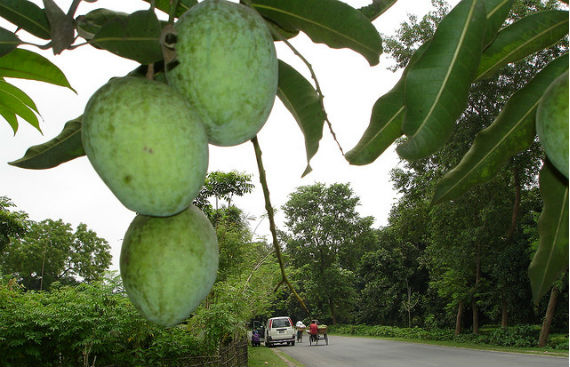
Permaculture on the Highways and Roadsides – a new dimension for Food Security
Roads and highways comprise 20,947.73 km of which national highways: 3,478.42, regional highways: 4,221.52 km and roads 13,247.79 km have occupied a significant arable land of the country. Roads and highways are constructed mostly above the normal flood level. Considering width 2 m X2 for the highways and 1 m X2 for the roads, the total available land area along the roads and highways stands 5,730 hectare can be utilized with Permaculture. Other than these, there are huge road networks throughout the country where we can grow some crops for the benefit of our livelihoods and food security.
Permaculture means intensive cropping without disturbing or damaging the natural habitat and biodiversity and is widely practiced in the modern world for growing crops with little or no disturbance of the soil and landscape using little or no tillage practice. It is also called as sustainable agriculture, organic farming, and very recently Climate-smart agriculture. Continue reading
Opportunities for Permaculture in the Rural Homes of Bangladesh
Permaculture is a widely used termed by the modern world. Permaculture means permanent culture especially, cropping without disturbing or damaging the natural habitat and biodiversity. It is the practice for growing crops with little on no disturbance of the soil and landscape by little or no tillage practice. It is also called as sustainable agriculture, organic farming, and very recently Climate-smart agriculture. Continue reading
Biodiversity Conservation and Food Security of Indigenous People Hilly Regions of Bangladesh
Bangladesh occupies an area of 144,863 km². The hilly areas cover about 17,342 km² mostly in the Chittagong Hill Tracts districts, Chittagong, Habigonj and Moulvibazar. Hills constitute about 12 per cent of the total area of Bangladesh. Chittagong Hill Tracts districts alone covers 13,184 km² which is about 9%. Based on geology and landform, the hills of Bangladesh may broadly be subdivided as: High hill ranges (about 70%) and Low hill areas (about 30%). The high hill ranges, about 200-1,000 m above mean sea level (msl), are steep to very steep hills and usually have a rather youthful soil mantle ranging from a few cm to several metres in thickness over bedrocks. In contrast, the low hill areas, about 15-200 m above msl are nearly flat or rounded topped and usually have old and deep soil. The whole hilly region receives more than 2000 mm precipitation annually about 80% of which receives in 4 months (June-September) and the region was covered by tropical climax forest with diversified flora and fauna just a century back. Continue reading
Bandarban: A place with many opportunities
Bandarban Hill District is one of the most potential resourceful regions of Bangladesh. The hills are not very old but in the vicinity of the Bay of Bengal they receive huge monsoon rainfall and have high water tables.
Many indicator plants like wild bananas, terrestrial orchids, ferns, Lycopodiums, Tara and arums are growing luxuriantly even on the hilltops. High hills, rivers and natural lakes and springs are the most attractive places for the tourists. Twelve different tribes including Bengalis of different religions are leaving there peacefully for a long time. Continue reading
Challenge of Adaptation of Agricultural Crops to Cope with Climate Change
SUMMARY
Agriculture needs a significant transformation to meet the challenges of achieving climate change adaptation and food security. Based on population growth and consumption patterns, projections indicate that agricultural production will have to increase at least 70% to meet the demands by 2050. Estimation indicates that climate change is likely to reduce agricultural productivity, production stability and incomes in some areas that already have high levels of food insecurity. Thus, development of sustainable agriculture is crucial to achieve future goals on climate change and food security. Agricultural productivity varies on climatic regions; therefore, knowledge about management of landscape, habit and habitats of plants and animals are the critical factors for adaptation and sustainable agriculture. This paper investigates into some of the key scientific and technical responses and ecosystem services required to have sustainable agriculture. Biodiversity is the root of plenty and provides greater scope for agriculture in the quickly changed climatic conditions. This paper outlines a range of practices, approaches and tools aimed at increasing the resilience and productivity of agricultural production systems, while also reflects light on reducing and removing emissions. It also considers current scientific knowledge and financial gaps and makes innovative suggestions regarding the combined use of different sources and dissemination of appropriate knowledge of adaptations to cope with the climate change Continue reading